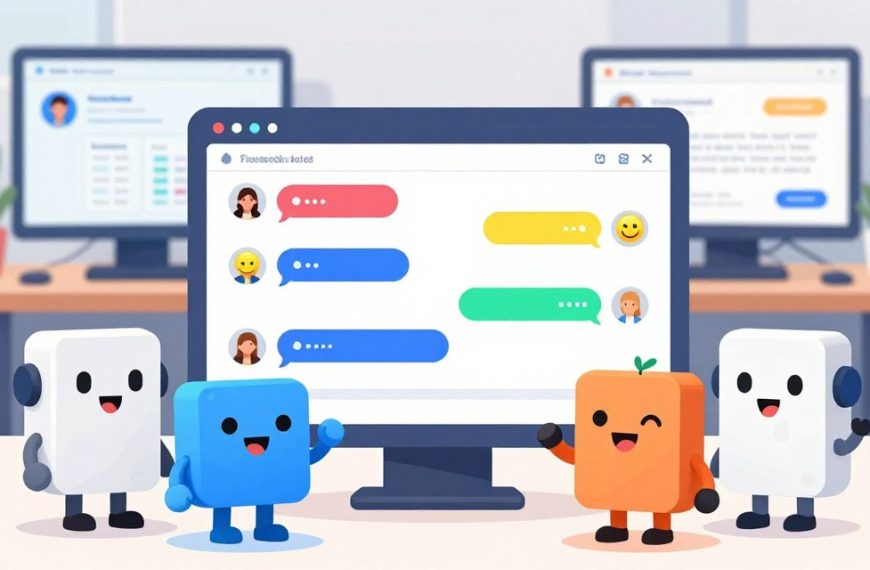
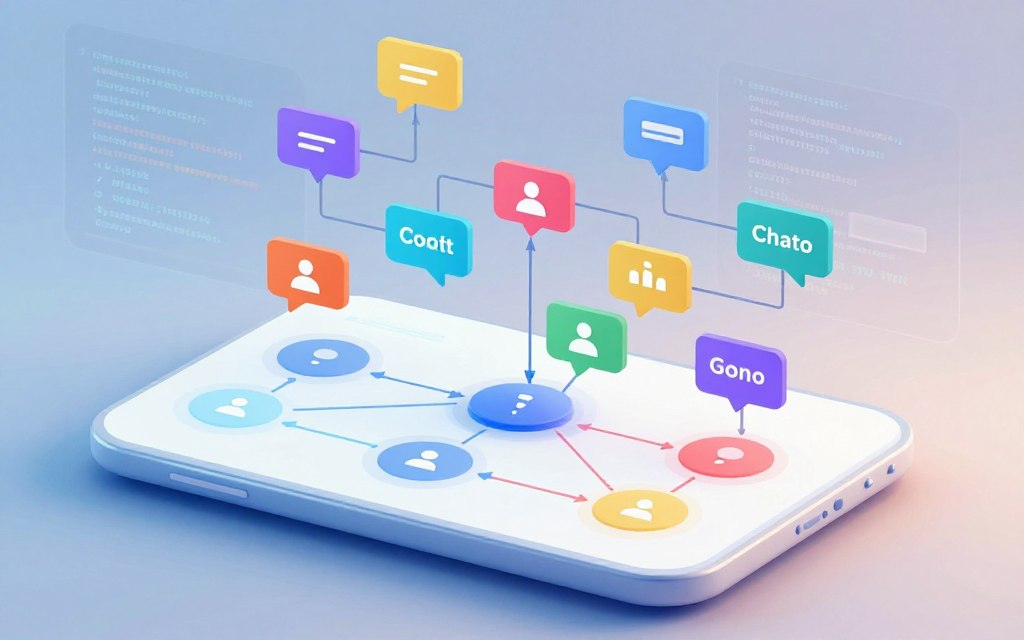

A rule-based chatbot definition is about a programmed chat system. It talks to users in real-time using set rules and paths.
These chatbots don’t have real AI. They don’t learn from chats or change how they act. Every question and answer must be written down before.
Think of it like a simple decision tree. User answers guide the chat along a set path to a fixed end.
Even though it seems simple, this method is very reliable. Companies love it for handling regular, standard questions.
Looking into how these systems work shows their lasting importance. They’re great for automating customer service and other important tasks.
What Is a Rule-Based Chatbot? Defining the Core Technology
A rule-based chatbot is the simplest form of automated chat. It follows a set of rules, not artificial intelligence. It’s a program that talks to users by following a list of instructions. Unlike smart systems, it sticks to a set path, offering clear answers but not much flexibility.
The Foundation of Automated Dialogue: Rule-Based Systems
These systems are key in automated customer service and simple tools. They work in a clear, predictable way. A rule-based chatbot doesn’t think or learn. It just reacts to what users say with set answers.
This makes it like an interactive flowchart or a decision tree chatbot. Every chat path is planned by a person. As one source says, the chatbot leads conversations step by step along these paths.
“At their core, rule-based chatbots operate like structured decision trees, guiding conversations step by step.”
If-Then Logic: The Unchanging Principle at the Heart of Simplicity
The whole system runs on “if-then” logic, from computer programming. This idea is very simple:
- IF a user asks about opening hours,
- THEN the chatbot tells them the hours.
- IF someone wants to reset their password,
- THEN the bot shows them how to do it.
There’s no room for doubt. The bot checks what the user says and acts accordingly. This makes the chat reliable but means designers must think of all possible questions.
From Programming Fundamentals to Conversational Flow
Using programming basics makes the chat flow work. Things like if-else statements and variables help with the chat. For example, a variable can remember a user’s name for personal messages.
Turning code into chat means scripting every possible chat. The developer makes a map, or decision tree, for each choice. This makes the chat feel natural for users looking for simple answers or tasks.
The core of a rule-based system is its clear, strict structure. It’s great for when chats are simple and follow a set pattern. It’s a solid base for more complex chats later.
Simple Decision Trees Explained: The Chatbot’s Navigational Map
Imagine a flowchart where every question leads to a specific answer. This is what a rule-based chatbot’s decision tree is all about. It’s a key part of how rule-based chatbots work, turning complex logic into a clear conversation path. It gives the bot a reliable map for talking to users.
Visualising Conversations as a Flowchart
Understanding a chatbot’s decision-making is easier with a flowchart. Each box is a step in the chat, and arrows show the path based on what the user says. Many chatbot builders, like ManyChat or Chatfuel, make it easy to create these flowcharts. You just add nodes for questions and answers and connect them, making the bot’s logic without coding.
Every decision tree has three main parts that mirror a chat’s structure. Knowing these parts is crucial for making an effective bot.
- Root Node: This is where every chat starts. It’s usually the bot’s first greeting, like “Hello! How can I help you today?”
- Decision Points (Branches): These are where the bot checks what the user says. Based on what’s typed, the chat goes down a certain path. For example, if someone asks about their order status, the bot follows the path for that.
- Endpoints (Leaves): These are the chat’s final points. An endpoint gives the bot’s final answer or action, like giving tracking info or answering a question.
Constructing a Practical Dialogue Path
To make a useful chatbot, you need to map out these trees for different user paths. The aim is to create paths that feel natural and guide users well. You write rules at each decision point to direct the chat based on specific triggers.
Example: Tracing a Path in a Customer Support Query Tree
Let’s look at a real example to see how rule-based chatbots work. Imagine a user asking an e-commerce store’s bot a question.
- The root node starts: “Welcome to StoreBot! Are you checking an order status, need help with a return, or have another query?”
- The user says, “Where is my order?” The bot finds the keyword “order” and goes to the right decision point.
- This branch asks, “Please provide your order number.” The user gives it.
- The bot checks the number, looks up the info, and reaches an endpoint. It says: “Your order #12345 is out for delivery and will arrive today by 5 PM.”
This whole chat was set up by the decision tree. The bot stayed on track, offering a consistent experience. But it can’t handle unexpected questions like “Is the delivery driver friendly?”
The Synergy Between Rules and Trees: How the System Operates
To make a rule-based chatbot work well, you need to understand how rules and decision trees work together. Each part is useful on its own but together, they make a system that can have detailed conversations. This teamwork turns a list of commands into a dynamic experience for users.
The heart of this system is the trigger-response mechanism. When a user types something like “forgot password,” the system knows what to do. It uses this simple idea to make the whole conversation flow smoothly.
Rules as Commands, The Decision Tree as the Road Network
Think of rules as the traffic laws of a city. A rule like “IF user says ‘opening hours’, THEN respond with ‘We are open 9am-5pm weekdays'” is clear and must be followed. These rules are strict and always the same.
The decision tree is like the city’s road network. It shows all possible paths a conversation can take. It connects rules in a way that makes sense for different user needs. While rules tell the bot what to do, the tree shows how to do it in order.
It’s important to keep rules and trees separate. Rules have the answers and actions. The tree shows how to use those answers in the right order. Building a chatbot is like setting up the laws and the roads for them to follow.
Guiding the User: A Step-by-Step Sequential Experience
The system guides the user step by step. The user never has to guess what to say next. Each response helps narrow down the options, leading to a useful outcome.
For example, a customer service chatbot might start with a menu. After choosing “Technical Support,” it leads to rules for common problems. Each answer leads to a more specific rule, until the problem is solved.
The table below shows how these parts work together to guide a conversation:
| System Component | Primary Role | Analogy | Contribution to User Experience |
|---|---|---|---|
| Individual Rule | Executes a single, conditional command (If-Then). | A traffic signal or sign. | Provides an immediate, accurate response to a specific input. |
| Decision Tree | Maps all possible conversational paths and connections. | The city’s street map and intersections. | Creates a logical structure, preventing dead-ends and confusion. |
| Trigger (User Input) | Initiates a rule by matching keywords or patterns. | A driver stating a destination. | Starts the interaction and defines the initial direction. |
| Overall System | Integrates rules and trees into a unified process. | The complete, functioning transport network. | Delivers a coherent, end-to-end guided conversation from start to finish. |
This flow is key to a good rule-based system. The user feels in control but the bot only allows certain paths. This makes conversations efficient and predictable, perfect for situations where clarity is important.
The main goal in building a chatbot is to achieve this perfect balance. Rules handle the small details, while the tree oversees the big picture. Together, they form a powerful tool for automating conversations.
Deconstructing a Chatbot Rule: Triggers, Conditions, and Actions
To understand how a rule-based chatbot works, we need to look at its basic part—the rule. Each rule is a set of instructions for one part of the conversation. It works like this: when a certain condition is met, do a specific action. This simple rule is what makes the whole trigger-response system work, leading to clear and controlled talks.

Identifying User Input: Keyword Matching and Pattern Recognition
The first part of any rule is to understand what the user wants. This is the ‘trigger’ phase. Chatbots look for specific words in what the user says. For example, if someone asks about delivery, the chatbot might look for words like “delivery”, “shipping”, or “track”.
Developers also use pattern matching to make the chatbot more flexible. This lets the bot understand different ways of asking the same question. So, “when will my * arrive?” could match “when will my parcel arrive?” and “when will my order arrive?”, where the asterisk is a wildcard.
The Strengths and Shortcomings of Literal Phrase Detection
Using keywords and patterns has its benefits. It makes the system very reliable and predictable. Developers know exactly what will trigger a response, making it great for structured tasks. This is why many chatbots are seen as a form of artificial intelligence, even if it’s a simpler one.
But, there are downsides. This method can’t handle different ways of saying things. If someone uses a synonym or spells something wrong, the chatbot might not understand. It’s not really understanding the conversation; it’s just matching words. This makes it hard for the chatbot to have open-ended conversations.
Formulating the Bot’s Output: Responses and Follow-Up Actions
When a condition is met, the rule’s action part kicks in. This is where the chatbot gives useful information or helps the user achieve a goal. The action can be anything from sending a message to doing more complex tasks.
From Static Text to Dynamic Integrations: Types of Responses
The actions a rule can take vary a lot. The simplest is a fixed text message, like “Our store hours are 9 AM to 5 PM.”
More advanced responses include:
- Button or Menu Prompts: Showing clickable options to guide the user.
- Data Collection: Asking for information and saving it for later.
- Dynamic API Integrations: Getting live data, like a current account balance.
- Handoff Actions: Passing the conversation to a human when needed.
This shows how a simple rule-based system can create useful automated experiences. It can do a lot without needing machine learning.
How to Build a Basic Rule-Based Chatbot: A Foundational Guide
Creating a basic rule-based chatbot is easy, not hard. It needs a step-by-step approach to designing conversations. This turns a clear goal into a reliable automated helper. For small businesses, a rule-based chatbot for customer service can start working fast, often in just one day. The secret is to follow a simple, four-step method.
Success depends on knowing what users will ask. You must think of all possible answers. This guide will show you how to do this, from the start to when it’s ready to use.
Step 1: Scoping the Bot’s Purpose and Defining Boundaries
Every project needs a clear goal. Decide what your chatbot will do. Will it answer common questions, book appointments, or check sales leads? A focused goal is key.
It’s also important to know what the bot won’t do. For example, a customer service bot might answer about returns but not fix technical issues. This avoids user frustration and keeps the project simple. Write down what the bot can and can’t do before you start.
Step 2: Mapping the Entire User Journey with a Decision Tree Diagram
With a clear goal, you can plan the conversation. A decision tree diagram is your chatbot’s guide. Start with the user’s first question or greeting. Then, add every possible answer they might give.
This diagram should cover all possible paths, including dead ends and successful answers. Use flowcharts or special software to help. It ensures you’ve thought of every important conversation path. It’s the main guide for your chatbot’s conversations.
Step 3: Authoring the Rule Set and Conversational Scripts
This step turns your diagram into real rules and scripts. For each part of your diagram, write a rule. This includes setting triggers and defining the bot’s response.
Writing scripts needs care. Use friendly, professional, and clear language. Prepare different answers for common questions to avoid sounding too robotic. Each message should lead the user to the next step in the conversation. This is where your rule-based chatbot for customer service gets its personality.
Step 4: Rigorous Testing, User Feedback, and Refinement
Testing is crucial before launching your chatbot. Start with internal tests where team members try to find its limits. Check every path to make sure it works right. Look for typos and unclear phrases in your scripts.
Then, get feedback from real users. See where they get stuck or ask questions the bot can’t answer. This feedback is key for making improvements. Use it to add new rules, clear up responses, and make the user journey smoother. Keep testing and tweaking even after it’s live to keep it working well.
Primary Use Cases: Where Rule-Based Chatbots Excel
Rule-based chatbots are great for specific tasks. They work well in places where things are predictable and need quick, accurate answers. They help with customer service and support for employees, freeing up humans for harder tasks.
Automating Customer Service and FAQ Resolution
Rule-based chatbots are perfect for answering common customer questions. They work 24/7, giving quick answers to frequent queries. This cuts down wait times and saves money.
Big names like H&M and Lufthansa use them for customer service. They answer questions about orders, flight status, and more. Banks also use them for balance checks and transactions.
- Provides immediate answers to frequent questions.
- Operates around the clock without fatigue.
- Standardises information delivery across all customer touchpoints.
Qualifying Sales Leads and Gathering Structured Data
Chatbots are great at guiding potential customers through a series of questions. They help sort leads based on their needs and budget. This makes sales efforts more focused.
The bot’s structured approach ensures all important information is collected. It gets contact details and product interests before passing on hot leads to sales reps. This builds a valuable database for marketing.
“A well-designed qualification chatbot acts as a tireless, initial sales development rep, ensuring human agents only spend time on leads that are truly sales-ready.”
Facilitating Simple Appointments, Orders, and Bookings
For simple tasks, rule-based chatbots are the best choice. They guide users through booking appointments, making reservations, or checking in for flights.
The chatbot offers clear options and collects the needed details. It confirms bookings in a familiar interface. This is common in:
- Healthcare: Scheduling appointments and sending reminders.
- Hospitality: Making reservations and handling room service orders.
- E-commerce: Helping users place orders for standard items.
Streamlining Internal Processes for HR and IT Helpdesks
Inside companies, chatbots help with employee queries. They save a lot of time for HR and IT teams.
An IT helpdesk bot handles password resets and guides on software installation. An HR chatbot answers questions about holidays, payslips, and benefits. It also manages leave requests.
This automation lets experts focus on complex issues. Employees get answers anytime, boosting productivity and happiness at work.
The Compelling Advantages of Opting for a Rule-Based Approach
Choosing a rule-based chatbot brings clear benefits. It ensures consistency, transparency, and speed. Many organisations find these systems practical and powerful. They offer reliable automation without the complexity of advanced AI.
Rule-based chatbots are easy to set up and cost-effective. Their design focuses on control and predictability. You decide what the bot says and how it responds, keeping interactions in line with your brand and guidelines.
Guaranteed Consistency and Complete Developer Control
This is a key advantage. A rule-based chatbot works within a clear framework. Its responses come from a pre-written script, based on specific triggers.
This leads to perfect message consistency. Every customer gets the same accurate answer to common questions. There’s no risk of the bot giving off-brand responses. Developers and managers have full control over the conversation and the information shared.
Transparent Logic and Straightforward Troubleshooting
Every bot action is tied to a specific, human-readable rule. This makes the system’s logic transparent. If a chatbot fails to respond correctly, the problem is easy to find.
You can quickly identify the issue, whether it’s a missing keyword or a broken link in the decision tree. This simplicity makes maintenance and updates easy. Industry commentary notes, “Their simplicity makes them reliable, predictable, and easy to maintain.”
Rapid Implementation and Lower Development Costs
Building a rule-based chatbot is faster and cheaper than AI-driven ones. There’s no need for extensive training data or ongoing machine learning oversight.
The development cycle is shorter. Teams can create a functional prototype in days or weeks, not months. This speed means lower upfront and ongoing costs, making advanced automation accessible to projects with limited budgets.
Accessibility for Non-Specialist Developers and Businesses
Intuitive, no-code and low-code chatbot platforms have made this technology accessible. Business analysts, marketing teams, and customer service managers can now build and manage effective bots without coding.
These visual editors let users create dialogue trees and define rules easily. This empowerment reduces the need for expensive software engineering resources. It allows departments to solve their own automation challenges quickly and independently.
In summary, the advantages of rule-based chatbots make them a compelling choice for standardised, high-volume interactions. They offer control, clarity, and cost-effectiveness, well-suited to many essential business functions.
Acknowledging the Inherent Constraints and Drawbacks
No technology is perfect, and rule-based chatbots have their limits. It’s important for businesses to know these to set realistic goals. They work well for structured tasks but struggle with the unpredictability of human talk and changing business needs.
The Struggle with Unscripted Questions and Linguistic Variation
The biggest limitation of rule-based chatbots is their narrow scope. They only follow their pre-written script and rules. As one analysis points out, “They can’t have complex conversations or answer unknown questions.”
Any question asked differently, with synonyms or typos, can confuse the bot. For example, “What’s your returns policy?” might get a correct answer, but “How do I send something back?” could confuse it. The bot can’t understand these as the same question.
This makes them bad for open-ended talks or topics needing subtlety. They can’t guess what you mean from what’s not in their rules.
Maintenance Demands and Scalability Concerns
Rule-based chatbots need a lot of maintenance. Every change in products or policies means updating the rules and decision tree. This needs a developer or specialist.
This process is hard and takes a lot of time. In complex areas, the decision tree can get too big. This makes it hard to manage and increases the chance of mistakes.
When you want the chatbot to cover more topics, you need a lot more rules. This can slow it down and make it more expensive to keep running.
The Inability to Learn from Interactions or Personalise Responses
A big problem is that a rule-based system doesn’t get better on its own. It deals with each chat as a new one, without remembering past talks. It can’t use past data to find trends or solve common problems.
So, it can’t personalise its answers. Every user gets the same thing, no matter what. It can’t make recommendations or adjust its tone based on how you feel.
This means the bot’s smarts are stuck at the last time it was updated. It can’t change on its own to fit how users behave.
| Constraint Category | Core Limitation | Typical Business Impact |
|---|---|---|
| Handling Unscripted Input | Cannot process questions or phrasing outside its pre-defined rules and keyword library. | Increased user frustration and failed interactions, leading to more escalations to human agents. |
| System Maintenance | Requires continuous manual updates to rules and decision trees as business needs evolve. | Ongoing resource costs for development and testing, slowing down the pace of change. |
| Learning & Adaptation | Lacks ability to learn from conversation history or personalise responses for individual users. | Missed opportunities for improved customer engagement, upselling, and proactive service. |
Knowing these drawbacks doesn’t mean giving up on the tech. It’s a key step in planning how to use it. It helps teams use rule-based chatbots where they’re best, as part of a bigger customer service plan.
Rule-Based Versus AI Chatbots: A Clear-Cut Comparison
Choosing a chatbot for your business is a big decision. It’s often between rule-based systems and AI chatbots. Each choice affects the bot’s abilities, cost, and upkeep. Knowing the main differences helps pick the right one for your business goals and user needs.
The difference between these two is not just about how advanced they are. It’s about how they work. One follows a set path, while the other learns as it goes.
Fundamental Philosophies: Deterministic Rules vs. Probabilistic Learning
A rule-based chatbot works in a set way. It follows rules set by developers. It’s like a train on tracks, always giving the same answers to the same questions.
An AI chatbot learns from lots of conversations. It gets better at understanding what people mean. It can answer questions it wasn’t programmed for, but it’s not always perfect.
A Side-by-Side Analysis: Flexibility, Data Dependency, and Complexity
The main difference shows in how they work. Here’s a table to help you see the main points.
| Aspect | Rule-Based Chatbot | AI Chatbot (NLP/ML) |
|---|---|---|
| Flexibility & Handling Unpredictability | Low. Works well within its limits but struggles with new or different questions. | High. Can understand new questions and handle free-flowing conversations. |
| Data Dependency & Learning | None. Doesn’t need training data, just clear rules. | Extensive. Needs lots of data to learn and keep improving. |
| Implementation Complexity & Control | Low to moderate. Easy to understand and control by developers. | High. Requires data science skills; its decisions can be hard to understand. |
| Cost & Speed to Launch | Generally lower cost and quicker to start. | Higher initial cost and longer to develop and fine-tune. |
| Maintenance & Updates | Manual. Needs a programmer for each new scenario or question. | Can be automated. Gets better with more data, but still needs checking. |
Selecting the Appropriate Technology for Your Needs
The right choice depends on your specific needs, resources, and how you feel about uncertainty. There’s no one-size-fits-all solution. You need to carefully consider what you need first.
Think about your situation: Is your conversation area simple and clear? Do you need absolute consistency and control? What’s your budget and timeline? Your answers will guide you to the best choice, which might even be a mix of both.
Specific Scenarios Where Rule-Based Bots Are the Optimal Solution
Rule-based chatbots are great for certain tasks because of their reliability and cost-effectiveness. They’re perfect for:
- Structured Customer Service FAQs: Answering common questions about returns, shipping, or hours.
- Form-Based Data Collection: Qualifying leads, conducting surveys, or booking appointments with specific information.
- Internal Process Navigation: Helping employees with IT helpdesk tickets or HR policy queries.
- Regulatory or Compliance-Driven Interactions: Where exact wording and process are crucial for compliance.
- Projects with Limited Budget or Technical Expertise: For small businesses or non-technical teams to quickly get a working assistant.
In these cases, the predictability and lack of learning of rule-based systems are their biggest strengths. The choice between rule-based vs AI chatbot is not about which is more advanced. It’s about which fits your specific needs best.
The Evolving Role of Rule-Based Systems Amidst AI Advancement
The idea that AI will replace rule-based chatbots is wrong. Instead, these systems are being used in new ways. They are not being thrown away but are being used in a more advanced way.
These systems are good at being predictable, controlled, and clear. Now, they are even more valuable in certain situations. They are being used in new ways, making them more accessible and special.
The Rise of the Hybrid Chatbot: Integrating Rules with Machine Learning
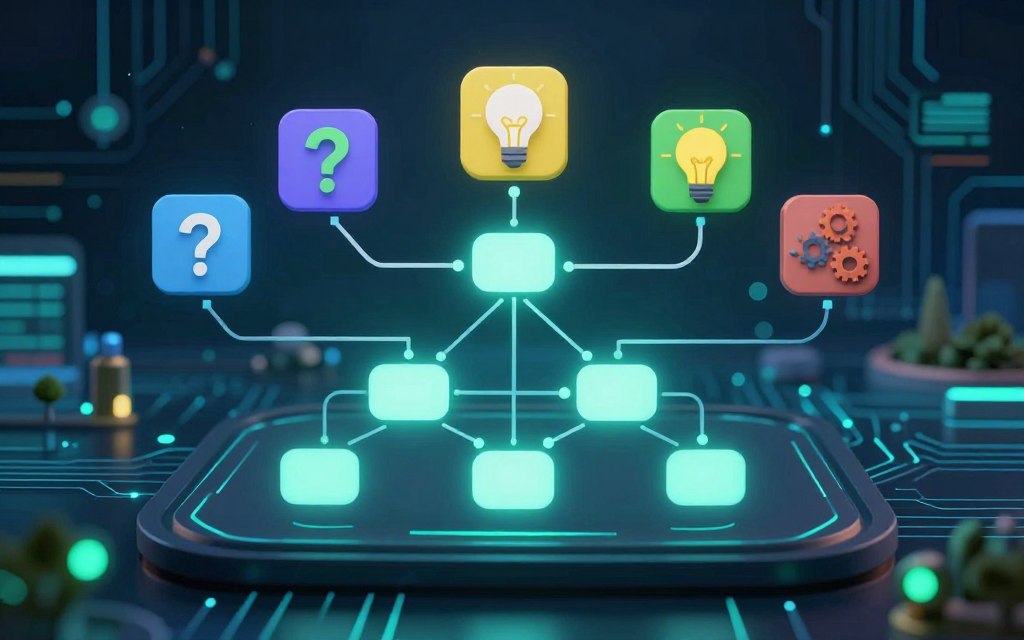
Today, chatbots are mixing rules with AI. This mix uses the strengths of both. The rule engine handles tasks that need to be done in a certain way.
The AI part deals with questions that are not straightforward. It understands what the user wants and gives personal answers. For example, a bot might use rules to guide a user through a problem-solving process. If the user asks something different, the AI can handle it.
This mix makes chatbots more useful and natural. As one expert said,
“The future isn’t a choice between rules and AI, but a thoughtful architecture that knows when to use each.”
Enduring Relevance in High-Standardisation, Low-Ambiguity Domains
Rule-based systems are still the best choice in some areas. Places that need strict rules, consistency, and no confusion are perfect for them.
Think of places like regulatory FAQs, booking processes, or IT support. In these areas, following a set path is crucial. The bot must stick to the rules.
This makes rule-based chatbots great for finance, healthcare, and law. They ensure every interaction is correct and follows the rules. Their value comes from being precise and reliable.
Improvements in Developer Tools and User Experience Design
Big changes have come from better tools from rule-based chatbot providers. Companies like ChatBot, Chatfuel, and ManyChat have made it easier to create chatbots.
They offer easy-to-use tools that let anyone create complex chatbot flows. Making a detailed chatbot is now as simple as drawing a diagram.
For users, chatbots are now better too. They can use images, quick buttons, and smart logic. This makes even simple chatbots useful and enjoyable to use.
It’s easier to start using these tools, and you can make powerful chatbots. This means rule-based chatbots will keep being important for businesses of all sizes.
Conclusion
A rule-based chatbot follows a clear path. It uses simple rules to handle specific conversations. This makes it great for routine tasks.
Businesses find it practical. These chatbots give consistent answers and are easy to control. They’re also affordable to set up.
They work best for simple tasks like answering FAQs or collecting data. Users just want accurate help, not complex AI.
Looking at rule-based chatbot examples helps understand their role. They’re strong for customer service and internal tasks. For more on this, check out the definition of a rule-based chatbot.
Starting with a rule-based system can improve efficiency. It’s a smart first step.
FAQ
What is a rule-based chatbot?
A rule-based chatbot is a software that talks to users using set rules. It works like a flowchart, where it responds based on what the user says. Unlike AI chatbots, it doesn’t learn from conversations.
How does a rule-based chatbot actually work?
It follows a detailed decision tree. When a user talks to it, it looks for keywords and follows a rule. This rule tells it what to do next, like answering a question or checking an order.
What is the role of a decision tree in a rule-based chatbot?
The decision tree is the chatbot’s map for talking. It shows all possible conversations from start to finish. Each choice by the user leads to a specific response, keeping the chat on track.
How do the rules and the decision tree work together?
Rules are like instructions for the chatbot. The decision tree organises these rules into a user’s journey. The tree gives the structure, and the rules make the conversation happen.
What are the main components of a single chatbot rule?
A rule has two parts: a trigger and an action. The trigger finds what the user wants, like through keywords. The action is what the bot does next, like sending a message or asking more questions.
What is the first step in building a rule-based chatbot?
First, define what the bot will do clearly. It should handle a specific task well, like answering FAQs or collecting information. A focused bot works better than one trying to do everything.
In which business areas do rule-based chatbots excel?
They’re great for structured tasks. They’re used for answering common questions, qualifying leads, booking appointments, and more. They’re also good for internal tasks like resetting passwords.
What are the main advantages of using a rule-based chatbot?
They offer consistency and control in conversations. They’re easy to update and deploy quickly. They’re also accessible to non-tech teams, thanks to platforms like ManyChat.
What are the key limitations of a rule-based chatbot?
They can’t understand questions not in their script. They don’t learn or personalise. They need regular updates and can be hard to manage in complex areas.
What is the fundamental difference between a rule-based and an AI chatbot?
Rule-based chatbots follow set paths, while AI chatbots interpret natural language. AI chatbots need training data and are less predictable. Rule-based chatbots are more reliable for simple tasks.
Are rule-based chatbots still relevant with the rise of AI?
Yes, they’re still key for tasks needing precision and cost control. They’re also used in hybrid models with AI for more complex conversations. This offers the best of both worlds.


 By
By